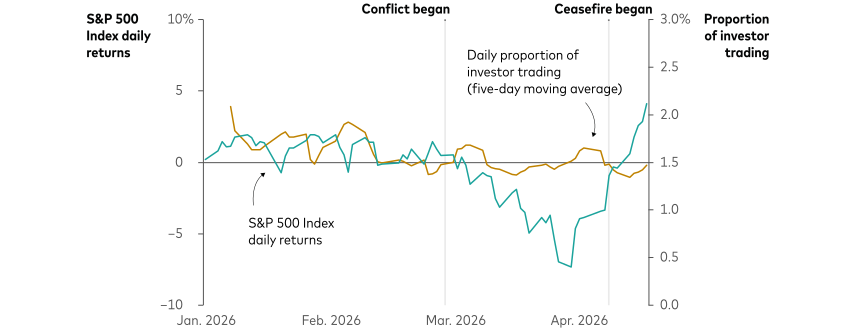
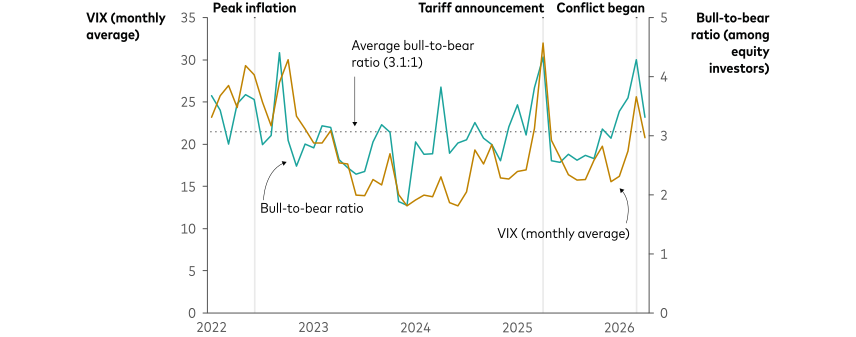
Notes: The bull-to-bear ratio is calculated by the ratio of the number of net buyers of equity and the number of net sellers of equity on a trading day. Daily figures were converted to a monthly average. VIX (the CBOE Volatility Index), sometimes called the “fear index,” is based on the prices of options on the S&P 500 Index and is a gauge of 30-day expected volatility of the U.S. stock market. Daily VIX levels were converted to a monthly average. Past performance is no guarantee of future returns. The performance of an index is not an exact representation of any particular investment, as you cannot invest directly in an index.
Sources: FRED for index data and Vanguard for data on retail investor transactions from January 1, 2022, through April 17, 2026.
Women traded less and bought more
Gender and age differences surfaced during the conflict.
Women were less likely to trade at all, with only 11% making trades compared with 16% of men. But among those who traded, women were more likely to be net buyers, with a higher bull-to-bear ratio (4:1) than their male counterparts (3:1).
"Staying the course continues to be a hallmark of long-term investing success,” said Fiona Greig, Vanguard’s global head of Investor Research and Policy. “Women are particularly coolheaded during market volatility and use it as an opportunity to buy the dip.”.
In addition, those who sold equities tended to be older, with a median age of 56, compared with 40 for net buyers and 48 for those who did not trade. This aligns with the reality that investors closer to retirement often have a lower tolerance for short-term swings, even when long-term plans remain intact.
Benefits of staying the course
Those who stayed invested through the volatility not only avoided locking in losses but also positioned themselves to capture the recovery that followed. Markets reward patience, and the data suggest that Vanguard investors understand this fundamental truth: The real risk isn't volatility itself, but abandoning a sound plan when the headlines turn dark.
Notes: All investing is subject to risk, including the possible loss of the money you invest.
Publication date: May 2026
The information contained in this material may be subject to change without notice and may not represent the views and/or opinions of Vanguard Investments Canada Inc.
Certain statements contained in this material may be considered "forward-looking information" which may be material, involve risks, uncertainties or other assumptions and there is no guarantee that actual results will not differ significantly from those expressed in or implied by these statements. Factors include, but are not limited to, general global financial market conditions, interest and foreign exchange rates, economic and political factors, competition, legal or regulatory changes and catastrophic events. Any predictions, projections, estimates or forecasts should be construed as general investment or market information and no representation is being made that any investor will, or is likely to, achieve returns similar to those mentioned herein.
While the information contained in this material has been compiled from proprietary and non-proprietary sources believed to be reliable, no representation or warranty, express or implied, is made by The Vanguard Group, Inc., its subsidiaries or affiliates, or any other person (collectively, "The Vanguard Group") as to its accuracy, completeness, timeliness or reliability. The Vanguard Group takes no responsibility for any errors and omissions contained herein and accepts no liability whatsoever for any loss arising from any use of, or reliance on, this material.
This material is not a recommendation, offer or solicitation to buy or sell any security, including any security of any investment fund or any other financial instrument. The information contained in this material is not investment advice and is not tailored to the needs or circumstances of any investor, nor does the information constitute business, financial, tax, legal, regulatory, accounting or any other advice.
The information contained in this material may not be specific to the context of the Canadian capital markets and may contain data and analysis specific to non-Canadian markets and products.
The information contained in this material is for informational purposes only and should not be used as the basis of any investment recommendation. Investors should consult a financial, tax and/or other professional advisor for information applicable to their specific situation.
In this material, references to "Vanguard" are provided for convenience only and may refer to, where applicable, only The Vanguard Group, Inc., and/or may include its subsidiaries or affiliates, including Vanguard Investments Canada Inc.
[1] Zooming out, during the market drawdown from January 27 to March 30, 17% of investors traded, twice as many as during the rapid recovery (8%) from March 31 to April 15. In both periods, most traders were net buyers, but buying was especially strong during the decline, with a bull-to-bear ratio of nearly 4-to-1 versus 3-to-1 in the rebound.