
Canada 2026 Q4 Outlook: Navigating Trade Headwinds with Domestic Strength
A comprehensive analysis of Canada's economic outlook for 2026, delving into key areas such as growth, inflation, the labor market, and policy.
A comprehensive analysis of Canada's economic outlook for 2026, delving into key areas such as growth, inflation, the labor market, and policy.
Growth: Defying the pessimists in 2026.
The Canadian economy has proven more resilient than expected in 2026. Earlier concerns about a recession have faded following a strong rebound in activity during the second quarter. Real GDP expanded at a 3.3% annualized pace in Q2, supported by stronger exports, resilient consumer spending, recovering residential investment, and firmer business capital expenditures. Revised data also suggest that growth during the first half of the year was stronger than initially reported, leaving the economy with more momentum entering the second half of 2026.
Several constraints that weighed on growth in recent years have eased. Lower interest rates are supporting housing activity, household finances remain broadly healthy, and higher energy prices have provided a tailwind for Canada's resource sector. Domestic demand has held up better than expected despite elevated uncertainty, helping offset weakness in some trade-exposed industries.
Looking ahead, growth is likely to remain positive but modest. The main challenge is trade uncertainty. The recent escalation in U.S.-Canada trade tensions amid ongoing CUSMA review process are likely to weigh on business confidence and investment decisions. At the same time, longstanding structural challenges such as weak productivity growth and subdued business investment are headwinds to Canada's longer-term potential.
Our expectation is that growth settles near 1.5% through 2027, reflecting a balance between resilient domestic demand and persistent external headwinds.
Labor Market: Low-hire, low-fire environment creates challenges for job seekers
Canada's labor market has remained stable but unimpressive in 2026. The unemployment rate has hovered around 6.5%, close to its lowest level in two years, and evidence of broad-based labor market deterioration remains limited. However, headline stability masks a more uneven picture beneath the surface. Labor market weakness remains concentrated among younger workers and recent labor-force entrants, reflecting slower hiring in entry-level occupations and the continued normalization of post-pandemic labor demand. By contrast, employment conditions for prime-age workers have remained comparatively healthy, helping support consumer spending and overall economic activity.
Slower population growth has also helped improve the balance between labor demand and labor supply. Combined with moderating wage growth, this suggests labor market conditions are normalizing rather than deteriorating. Looking forward, we expect labor market conditions to remain broadly stable through 2027. Growth is likely to be sufficient to support ongoing employment gains, while persistent economic uncertainty should prevent labor demand from overheating. As a result, unemployment is expected to remain near current levels, fluctuating around the mid-6% range over the next year.
Inflation: Nearing the Finish Line
Geopolitical developments and resulting higher energy prices have pushed headline inflation measures higher in recent months. Beneath these isolated pressures, however, underlying inflation trends are more encouraging. Core inflation measures remain anchored around 2%, suggesting that domestic inflation pressures are not an immediate concern for monetary policymakers.
The primary inflation risk now comes from the supply side. New tariffs, elevated energy prices, and potential disruptions to global supply chains could temporarily push prices higher in certain sectors. The key question is whether these pressures begin to influence inflation expectations more broadly. So far, evidence of meaningful spillovers remains limited, suggesting that most recent inflation pressures remain concentrated in externally driven categories.
Our expectation is that core inflation remains close to 2% through 2027, while headline inflation experiences modest volatility as energy prices fluctuate. Overall, inflation increasingly appears consistent with a soft-landing environment.
Canada inflation has largely normalized despite recent energy volatility
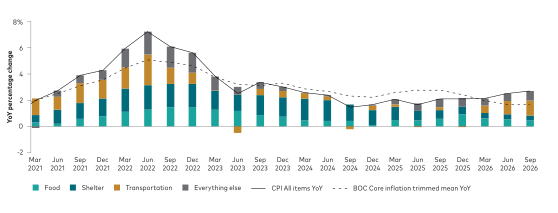
Source: Vanguard calculations based on data from Bloomberg. Data as of 9/16/2026.
Monetary Policy: Rethinking the neutral rate
The Bank of Canada has entered a period of patience, but that patience may not last much longer . After holding the overnight rate at 2.25% for an extended period, policymakers appear increasingly comfortable with the notion that the economy has largely achieved a soft landing. Growth has reaccelerated, the labor market has stabilized, and core inflation remains anchored despite energy prices and renewed trade disruptions. Recent communications from Tiff Macklem and other policymakers have also indicated a more hawkish tone regarding inflation risks, particularly those stemming from tariffs and broader supply-side pressures.
Meanwhile, the global policy backdrop has become less supportive. Expectations for additional tightening by the U.S. Federal Reserve have risen materially in recent months as inflation is proving more persistent than anticipated. Historically, significant policy divergence between the Federal Reserve and the Bank of Canada has been difficult to sustain, particularly when exchange-rate developments risk importing inflationary pressures into Canada. While the Bank is unlikely to mechanically follow the Fed, a more hawkish U.S. policy increases the likelihood that Canadian policymakers ultimately need to move rates higher as well.
Our baseline outlook now incorporates one 25-basis-point rate increase in 2026 and 2027, bringing the overnight rate to 2.75% by December 2027. However, if tariff-related costs prove more persistent, inflation expectations begin to drift higher, or economic growth continues to outperform expectations, policymakers may conclude that additional restraint is necessary.
A More Hawkish Fed Limits the Bank of Canada’s Room to Maneuver
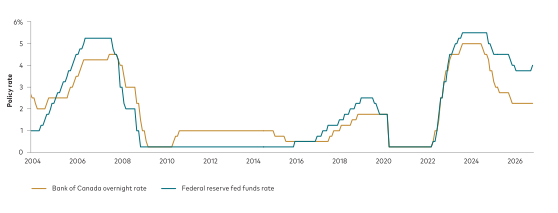
Source: US Federal Reserve and Bank of Canada. Data as of 9/16/2026.
Notes:
Publication date: October 2026
The information contained in this material may be subject to change without notice and may not represent the views and/or opinions of Vanguard Investments Canada Inc.
Certain statements contained in this material may be considered "forward-looking information" which may be material, involve risks, uncertainties or other assumptions and there is no guarantee that actual results will not differ significantly from those expressed in or implied by these statements. Factors include, but are not limited to, general global financial market conditions, interest and foreign exchange rates, economic and political factors, competition, legal or regulatory changes and catastrophic events. Any predictions, projections, estimates or forecasts should be construed as general investment or market information and no representation is being made that any investor will, or is likely to, achieve returns similar to those mentioned herein.
While the information contained in this material has been compiled from proprietary and non-proprietary sources believed to be reliable, no representation or warranty, express or implied, is made by The Vanguard Group, Inc., its subsidiaries or affiliates, or any other person (collectively, "The Vanguard Group") as to its accuracy, completeness, timeliness or reliability. The Vanguard Group takes no responsibility for any errors and omissions contained herein and accepts no liability whatsoever for any loss arising from any use of, or reliance on, this material.
This material is not a recommendation, offer or solicitation to buy or sell any security, including any security of any investment fund or any other financial instrument. The information contained in this material is not investment advice and is not tailored to the needs or circumstances of any investor, nor does the information constitute business, financial, tax, legal, regulatory, accounting or any other advice.
The information contained in this material may not be specific to the context of the Canadian capital markets and may contain data and analysis specific to non-Canadian markets and products.
The information contained in this material is for informational purposes only and should not be used as the basis of any investment recommendation. Investors should consult a financial, tax and/or other professional advisor for information applicable to their specific situation.
In this material, references to "Vanguard" are provided for convenience only and may refer to, where applicable, only The Vanguard Group, Inc., and/or may include its subsidiaries or affiliates, including Vanguard Investments Canada Inc.