
Freshness: Japan's higher rates raise stakes for global markets
How Japan’s rising rates may shift global capital flows and add pressure to bond yields.
How Japan’s rising rates may shift global capital flows and add pressure to bond yields.
Global competition for capital is growing, putting upward pressure on long-term interest rates. Japan, long a major supplier of capital to the rest of the world, is an important part of the story.
Japanese investors hold significant amounts of overseas bonds and equities, while the country’s exceptionally low interest rates have made the yen an important funding currency for global carry trades. If Japanese government bond rates continue to rise, as they have the last several years from near-zero levels, more capital could remain at home, potentially reducing an important source of demand for U.S. Treasuries and other global assets.
That dynamic was among those in play when the U.S. and Japan collaborated in late July to support the yen, which had depreciated to a near 40-year low against the U.S. dollar. Low policy interest rates had pressured the currency lower and rates higher amid concerns about accelerating inflation and central bank credibility in a strengthening economy.
Governments face substantial financing needs, technology companies are issuing debt to fund artificial intelligence investment, defense spending is rising, and central banks’ quantitative-tightening programs are returning more bonds to private markets. As investors demand greater compensation to absorb that supply, yields have moved higher across major markets.
“We’re increasingly seeing global competition for capital,” said Ales Koutny, Vanguard head of international rates. “As financing needs increase, markets are adjusting to find the yield levels that will attract sufficient private capital. Japan is central to that adjustment because higher domestic yields could change how Japanese investors compare opportunities at home and abroad.”
The yields attracting capital
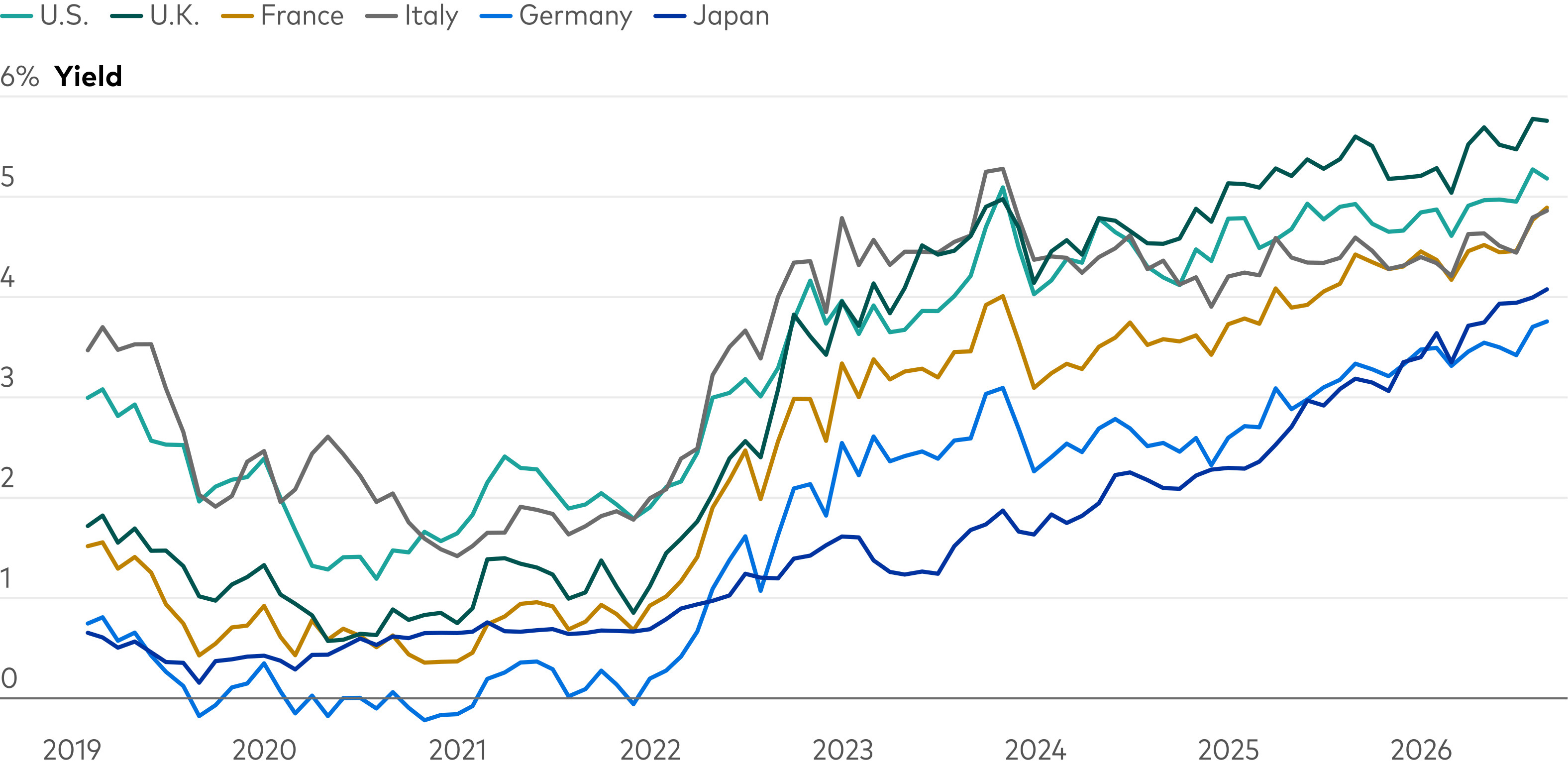
Note: Yields shown are for 30-year sovereign bonds.
Source: Bloomberg, as of August 26, 2026.
https://www.datawrapper.de/_/JDCrX/
The shift is being reinforced by Japan’s own economic momentum. Growth is increasingly supported by domestic demand, including strong wages, recovering consumption, and continued corporate investment. Grant Feng, a Vanguard senior economist, described Japan as a “high-pressure economy,” adding that “Demand is stronger than previously recognized, and structural labor shortages are contributing to wage growth.”
Inflation also appears to have broadened and become more domestically driven. An initial surge was heavily influenced by import costs and the weaker yen, but underlying inflation remains above the 2% target set by the Bank of Japan (BoJ) after adjusting for temporary government measures such as energy subsidies. Stronger demand, sustained wage gains, and widening price pressures all strengthen the case for additional monetary policy normalization.
“The question is no longer whether the BoJ will hike again, but how quickly,” Feng said. Vanguard recently increased its monetary policy forecasts for Japan. Feng expects two additional quarter-percentage-point increases in 2026, which would bring the policy rate to 1.5% by year-end, followed by further normalization to 2% in 2027.
Still, markets may be underestimating where Japanese rates ultimately settle. Although the BoJ has described a wide range of possible neutral rates (the theoretical rate at which monetary policy would neither spur nor inhibit economic growth), Koutny sees 2% to 2.5% as a more natural landing zone than the lower rates that markets have priced in.
The path will require balance. “Raising rates too slowly could prolong inflation and currency pressures,” Koutny said. “Moving too abruptly could strengthen the yen, weigh on exporters, and increase concerns about the government’s borrowing costs. Yet financial conditions remain accommodative, suggesting the BoJ has room to proceed gradually.”
For global investors, the key implication is clear. As its economy strengthens and its interest rates rise, Japan could increasingly compete for the same capital needed to finance governments, corporations, and AI investment worldwide. That shift may add another source of upward pressure to global yields in the years ahead.
Notes:
All investing is subject to risk, including the possible loss of the money you invest.
Bond funds are subject to the risk that an issuer will fail to make payments on time, and that bond prices will decline because of rising interest rates or negative perceptions of an issuer’s ability to make payments.
Investments in stocks or bonds issued by non-U.S. companies are subject to risks including country/regional risk and currency risk. These risks are especially high in emerging markets.
Bloomberg® and Bloomberg Indexes mentioned herein are service marks of Bloomberg Finance LP and its affiliates, including Bloomberg Index Services Limited (“BISL”), the administrator of the index (collectively, “Bloomberg”) and have been licensed for use for certain purposes by Vanguard.
Bloomberg is not affiliated with Vanguard, and Bloomberg does not approve, endorse, review, or recommend the Financial Products included in this document. Bloomberg does not guarantee the timeliness, accurateness, or completeness of any data or information related to the Financial Products included in this document.
Publication date: September 2026
The information contained in this material may be subject to change without notice and may not represent the views and/or opinions of Vanguard Investments Canada Inc.
Certain statements contained in this material may be considered "forward-looking information" which may be material, involve risks, uncertainties or other assumptions and there is no guarantee that actual results will not differ significantly from those expressed in or implied by these statements. Factors include, but are not limited to, general global financial market conditions, interest and foreign exchange rates, economic and political factors, competition, legal or regulatory changes and catastrophic events. Any predictions, projections, estimates or forecasts should be construed as general investment or market information and no representation is being made that any investor will, or is likely to, achieve returns similar to those mentioned herein.
While the information contained in this material has been compiled from proprietary and non-proprietary sources believed to be reliable, no representation or warranty, express or implied, is made by The Vanguard Group, Inc., its subsidiaries or affiliates, or any other person (collectively, "The Vanguard Group") as to its accuracy, completeness, timeliness or reliability. The Vanguard Group takes no responsibility for any errors and omissions contained herein and accepts no liability whatsoever for any loss arising from any use of, or reliance on, this material.
This material is not a recommendation, offer or solicitation to buy or sell any security, including any security of any investment fund or any other financial instrument. The information contained in this material is not investment advice and is not tailored to the needs or circumstances of any investor, nor does the information constitute business, financial, tax, legal, regulatory, accounting or any other advice.
The information contained in this material may not be specific to the context of the Canadian capital markets and may contain data and analysis specific to non-Canadian markets and products.
The information contained in this material is for informational purposes only and should not be used as the basis of any investment recommendation. Investors should consult a financial, tax and/or other professional advisor for information applicable to their specific situation.
In this material, references to "Vanguard" are provided for convenience only and may refer to, where applicable, only The Vanguard Group, Inc., and/or may include its subsidiaries or affiliates, including Vanguard Investments Canada Inc.