Active Fixed Income Perspectives Q4 2026: Looking through the fog
8 minute read
Expert perspectives

Active Fixed Income Perspectives Q4 2026: Looking through the fog

Despite ongoing uncertainty around inflation, deficits, geopolitics, and interest rates, the case for fixed income has strengthened. Higher yields provide attractive income and have materially improved prospective returns. Investors have taken notice: Recent strong demand reflects growing recognition that today’s yield environment offers compelling value across a range of potential outcomes.

Click here  for a downloadable PDF version of this web article.

Big picture: A justified increase in yields

What changed: Markets began the year expecting rate cuts, but have shifted direction due to a more resilient economic backdrop. This firm growth environment, combined with higher energy prices and surging global bond issuance, has forced global yields higher and increased dispersion across fixed income markets.

Why it matters: Despite ongoing uncertainty around inflation, deficits, geopolitics, and interest rates, the case for fixed income has strengthened. Higher yields provide attractive income and have materially improved prospective returns.


Rates and credit: Selectivity matters

Base case: Looking forward, we expect growth to remain strong and the labor market to remain stable. As inflation remains elevated, we expect the Fed to remove the insurance cuts delivered in 2025 while remaining sensitive to incoming data.. With U.S. yields around fair value, we're neutral on U.S. duration while volatility and dispersion are creating opportunities for relative value across regions and sectors.  

Mortgage-backed securities (MBS): We continue to find attractive opportunities in MBS and have increased our overweight, particularly in structures with more predictable cash flows and less extension risk.

Credit issuance surge: Record bond issuance has created sector dispersion, particularly in technology. We continue to favor investment-grade credit for its combination of yield, quality, and resilience.


Global rates: Dispersion creates opportunity. 

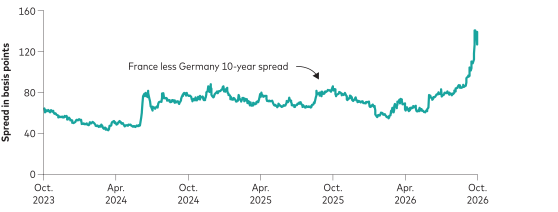
Global rate dynamics: Policy normalization in Japan and diverging fiscal dynamics in Europe are creating relative value across global rates markets. In Japan, the BoJ’s continued tightening has pushed government bond yields higher and flattened the yield curve as investors price a faster pace of normalization. In Europe, persistent inflation and renewed fiscal concerns have increased dispersion across sovereign bond markets, with France at the center of the repricing.

Active positioning: We remain underweight France and Italy relative to Germany amid elevated fiscal and political risks and continue to favor German Bunds relative to U.S. Treasuries. In Japan, we maintain a short-duration, curve-flattening bias while remaining overweight European inflation-linked exposure.


French OAT spread over German bunds

High-grade municipal yields attractive everywhere, most notably on the long end

Source: Bloomberg, as of September 30, 2026. Past performance is no guarantee of future returns. The performance of an index is not an exact representation of any particular investment, as you cannot invest directly in an index.


Takeaways to consider: 

  • Rates: Through mortgage-backed securities and global rates markets, opportunities for relative value and diversification have improved.
  • Credit: Investment-grade fundamentals remain solid, with higher yields providing attractive income even as spreads remain relatively tight
 
Vanguard Canada's new active Global Core-Plus Bond ETF (VCOR) is now available – learn more at https://www.vanguard.ca/en/latest-updates/introducing-vcor.        


Publication date: October 2026

Notes:

This document is published by The Vanguard Group, Inc., the indirect parent company of Vanguard Investments Canada Inc. It is not a recommendation, offer or solicitation to buy or sell any security, including any security of any investment fund or any other financial instrument. The information contained in this material is not investment advice and is not tailored to the needs or circumstances of any investor, nor does the information constitute business, financial, tax, legal, regulatory, accounting or any other advice. Research published by The Vanguard Group, Inc., may not be specific to the context of the Canadian market and may contain data and analysis specific to non-Canadian markets and products. The information is for informational purposes only and should not be used as the basis of any investment recommendation. Investors should consult a financial, tax and/or other professional advisor for information applicable to their specific situation.

For more information about Vanguard funds or Vanguard ETFs, visit vanguard.ca to obtain a prospectus or, if available, a summary prospectus. Investment objectives, risks, charges, expenses, and other important information about a fund are contained in the prospectus; read and consider it carefully before investing.

All investing is subject to risk, including possible loss of principal. Diversification does not ensure a profit or protect against a loss. Past performance is no guarantee of future results.

Past performance is no guarantee of future returns. The performance of an index is not an exact representation of any particular investment, as you cannot invest directly in an index.

Bond funds are subject to interest rate risk, which is the chance bond prices overall will decline because of rising interest rates, and credit risk, which is the chance a bond issuer will fail to pay interest and principal in a timely manner or that negative perceptions of the issuer’s ability to make such payments will cause the price of that bond to decline.

Investments in bonds issued by non-U.S. companies are subject to risks including country/regional risk and currency risk.

Municipal bond fund distributions, including any market discount recognized by the Fund’s investments, may be taxable as ordinary income or capital gains. A majority of the income dividends that you receive from the Fund are expected to be exempt from federal income taxes. However, a portion of the Fund’s distributions may be subject to federal, state, or local income taxes or the federal alternative minimum tax. You should consult your own tax advisor with respect to any particular U.S. or non-U.S. tax consequences of your investment in the Fund.