1. Let’s start with the basics—what is AI, what does the ecosystem look like, and who are the key players?

At a high level, the term AI typically refers to a computer building a system or solving a problem that normally requires human intelligence.

I think of the sector as breaking down into infrastructure—buildings, electricity, and chips—where the leaders there are companies such as NVIDIA and Broadcom on the semiconductor side and Celestica and Arista Networks on the networking side.

Then you have enablers. These include the foundational large language models, such as ChatGPT from Open AI, Claude from Anthropic, along the with cloud providers—the so-called hyperscalers, like Google, Microsoft, and Amazon that build their own models and host others models in their cloud infrastructure.

Then you have the applications that are built on this tech, including coding copilots, image/video generation, and software from companies like Adobe that are building this technology into their products. Finally, you have the beneficiaries like healthcare providers, banks, and financial institutions that are using AI to enhance efficiency.

What’s interesting and different in all of this is that the hyperscalers have started to sprawl out with capabilities and products that span the ecosystem.


2. What has been the biggest evolution in the AI story over the past few years?

I think the biggest evolution since the launch of ChatGPT came last year when Open AI introduced what is now called a reasoning model—a model that not only answered questions but critiqued and refined its own responses. The original models were just simulating the most likely answer to a given question. But they were easy to stump, and they made a lot of mistakes. The newer models are much more compute-intensive, and they take longer to think, but they produce much better results. So, that was a real step-function change, and the overall usage of these systems has grown exponentially.


3. What emerging uses of AI do you foresee that aren’t widely anticipated yet?

The big unlock I see coming is agentic AI that can do work on your behalf. Imagine giving ChatGPT access to Excel, Word, Outlook, FactSet, Bloomberg, and the internet so it can complete projects for you. It’s early to say this will work in 2026, but if these models can start using other software programs to achieve goals, there is a lot of potential for substantial growth in model use cases.

Preparing all data for AI is labor-intensive, but letting it interact with computers directly means it can learn, clean up information, and analyze much more efficiently. We haven’t seen this at scale yet, but I believe it will make AI far more useful for both enterprises and consumers. At home, it could be as simple as letting AI take control of your browser to book your vacation for you, not just plan it.


4. With that backdrop, are we in an AI stock bubble?

Most AI spending today shows positive, measurable return on invested capital across infrastructure and the cloud, and it meets strong demand. The infrastructure being built is producing attractive returns using reasonable assumptions, and AI is already impacting advertising, entertainment, and enterprise productivity in commercially viable ways.

As with any technology shift, there are always some areas we could call bubbles—maybe big, maybe small, or in specific spots. We saw things get inflated in 2021 and then correct in 2022, but overall, the current environment is not like the dot-com bubble. So, while there are pockets of hype and overexcitement, especially in private markets, where some of the financing may not fully understand the risks—I believe there are still tremendous investment opportunities in AI, provided the technology keeps advancing and delivering real value.


5. How do you define an AI “winner” in these early days, and who is leading?

To win in technology, you want to compete on something other than price. When you compete on price, your returns are limited; true winners build natural monopolies or near monopolies with a clear right to win and a moat.

In AI, I look at what each company brings to bear. Google has the lowest cost to serve because of custom hardware, a lot of data in important areas, and incredible distribution through its applications and hardware. Meta applies advertising technology where returns are among the highest worldwide. OpenAI has built enormous usage with ChatGPT—whether that remains as Gemini advances is something we’re watching. Anthropic has done an incredible job with engineering problems, seeing a lot of code generation directly on Claude and underpinning other providers, which may give it a natural edge.

But some companies that look like leaders today may end up also‑rans. Here, I’m talking about the so-called neocloud companies that rent GPU compute to the hyperscalers at inflated prices due to the current shortage. These companies may face economic challenges when supply catches up.

Meanwhile the hyperscalers have a durable advantage—the ability to redeploy capital and keep growing.


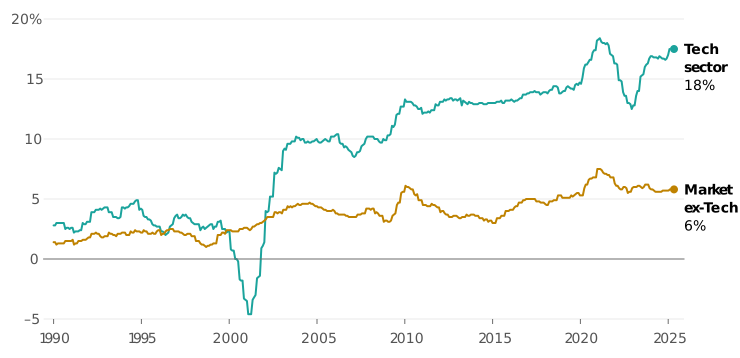
Technology’s edge: Benefiting from economies of scale    


Trailing four quarters free-cash-flow margins (January 31, 1990–May 31, 2025)

Trailing four quarters free-cash-flow margins (January 31, 1990–May 31, 2025)
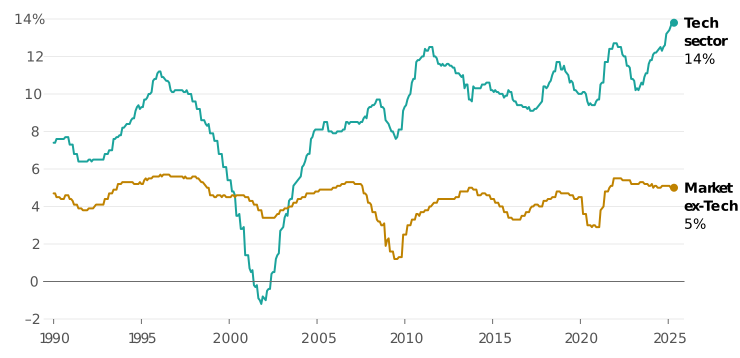
Trailing four quarters return on invested capital (January 31, 1990–May 31, 2025)

Trailing four quarters return on invested capital (January 31, 1990–May 31, 2025)

Notes: Analysis includes U.S.-listed stocks, excluding financials and REITs, because free cash flow is generally not an applicable metric for these sectors.

Sources: Goldman Sachs, corporate reports.

Past performance is not a guarantee of future returns. 


 6. How do you think about U.S. equity market concentration?

It’s possible that one or two of these companies will falter and lose their lead. One could have the view that AI changes the way we interface with technology and Google search becomes borderline irrelevant, though I do not. And if we move from typing and looking at our phones to talking and listening to a device, Apple may be less relevant. So competitive risks exist. That said, as I look at these companies today, each has different opportunities and threats, and there’s a lot of reasons to think that Google becomes significantly more relevant and a much bigger company in five to 10 years, Apple remains the dominant operating system for our lives, and Amazon continues to dominate in commerce. Meta may spend itself out of profit growth, but its core business has a long runway. The ingredients that led to their scale persist, if not intensified by AI, even as a new competitive environment slightly raises the chance of disruption.


7. What advantages does active management offer in navigating market concentration, and how does that shape your portfolio construction?

It’s an incredible opportunity. Owning a number of these companies has been the right decision, and I have no issue with one stock being a very large part of the portfolio when I look at risk relative to a benchmark. We’re trying to perform relative to a benchmark—not be up in a down market—so we use a benchmark‑relative active risk framework: “How much risk do I want in each position, and what does that look like at the portfolio level?” Big overweights or underweights are tools. If a company is on the wrong side of change, a really big underweight can generate alpha; when the market overreacts—say, on Google and AI—we can lean in. Concentration makes our jobs easier, not harder.


8. How can financial advisors use AI in their practice?

People who leverage advancements in technology can quickly become super performers. I’d lean in—be less afraid of disruption; I’d rather be the person who knows exactly how it’s going to work. Use AI to be as prepared as possible for every meeting; load as much information on your product set and clients as regulatorily allowed into your favorite model to get a prep memo. Let AI do the data retrieval and analysis and then go back and forth to set the agenda and questions so you can focus on the personal, differentiating parts of your interaction with clients.


Note: This interview was edited for length and clarity. The interviewee’s opinions don’t necessarily reflect those of Vanguard.

All investing is subject to risk, including possible loss of the money you invest. Diversification does not ensure a profit or protect against a loss.

Publication date: February 2026

The information contained in this material may be subject to change without notice and may not represent the views and/or opinions of Vanguard Investments Canada Inc.

Certain statements contained in this material may be considered "forward-looking information" which may be material, involve risks, uncertainties or other assumptions and there is no guarantee that actual results will not differ significantly from those expressed in or implied by these statements. Factors include, but are not limited to, general global financial market conditions, interest and foreign exchange rates, economic and political factors, competition, legal or regulatory changes and catastrophic events. Any predictions, projections, estimates or forecasts should be construed as general investment or market information and no representation is being made that any investor will, or is likely to, achieve returns similar to those mentioned herein.

While the information contained in this material has been compiled from proprietary and non-proprietary sources believed to be reliable, no representation or warranty, express or implied, is made by The Vanguard Group, Inc., its subsidiaries or affiliates, or any other person (collectively, "The Vanguard Group") as to its accuracy, completeness, timeliness or reliability. The Vanguard Group takes no responsibility for any errors and omissions contained herein and accepts no liability whatsoever for any loss arising from any use of, or reliance on, this material.

This material is not a recommendation, offer or solicitation to buy or sell any security, including any security of any investment fund or any other financial instrument. The information contained in this material is not investment advice and is not tailored to the needs or circumstances of any investor, nor does the information constitute business, financial, tax, legal, regulatory, accounting or any other advice.

The information contained in this material may not be specific to the context of the Canadian capital markets and may contain data and analysis specific to non-Canadian markets and products.

The information contained in this material is for informational purposes only and should not be used as the basis of any investment recommendation.  Investors should consult a financial, tax and/or other professional advisor for information applicable to their specific situation.

In this material, references to "Vanguard" are provided for convenience only and may refer to, where applicable, only The Vanguard Group, Inc., and/or may include its subsidiaries or affiliates, including Vanguard Investments Canada Inc.