Canada 2026 Q3 Outlook: A Softer Start to the Year Masks a Stable Underlying Economic Backdrop
A comprehensive analysis of Canada's economic outlook for 2026, delving into key areas such as growth, inflation, the labor market, and policy.

A comprehensive analysis of Canada's economic outlook for 2026, delving into key areas such as growth, inflation, the labor market, and policy.
Recent data suggest Canada slipped into a shallow technical recession over the turn of the year, with GDP falling at a 1.0% annualized pace in Q4 2025 and edging down a further 0.1% in Q1 2026. Even so, the weakness looks less alarming than the headline implies. Output was distorted by temporary factors, including a surge in gold imports and a temporary slowdown in defence spending, while final domestic demand has been resilient.
Trade policy uncertainty tied to the United States and the fate of CUSMA continues to restrain business confidence and delay non-residential investment, while elevated oil prices should provide a partial offset through improved trade volumes for a major energy exporter. Oil tailwinds should help growth rebound modestly through the middle of 2026, even if higher energy costs weigh on household spending and keep non-energy firms cautious. Reflecting the weaker starting point, we have lowered our 2026 GDP forecast to 1.5%, with only a modest improvement to 1.6% in 2027.
The labour market has remained broadly uninspiring, fluctuating within a 6.5% to 7.0% range and showing little sustained momentum in either direction. Recent weakness has been concentrated among younger and less-tenured workers, a composition that helps cushion the immediate impact on aggregate consumption. Still, softer hiring, declining home prices, and elevated energy costs may gradually encourage more precautionary saving and weigh on consumer spending.
Inflation, by contrast, has evolved in a more constructive direction. Core measures of price growth continue to moderate, giving the Bank of Canada greater scope to look through supply-driven increases in energy prices, provided inflation expectations remain well anchored. Demographic dynamics are also turning more supportive on this front. Canada has recorded three consecutive quarters of population decline, a development that is likely to exert additional disinflationary pressure through softer housing demand and reduced strain on services. Taken together, these forces support our view that monetary policy is likely to remain on hold through the end of 2027.
Labour market conditions, however, present a more nuanced picture. The recent rise in unemployment, particularly among younger workers does not appear to reflect widespread displacement from artificial intelligence. Rather, it is more consistent with cyclical and structural headwinds, including elevated trade uncertainty and a shift in the composition of labour demand. Over the past decade, demand for university-educated workers in Canada has increased by approximately 16%, while the number of graduates has risen by more than 63%. This divergence points to a growing imbalance between labour supply and demand at the post-secondary level.
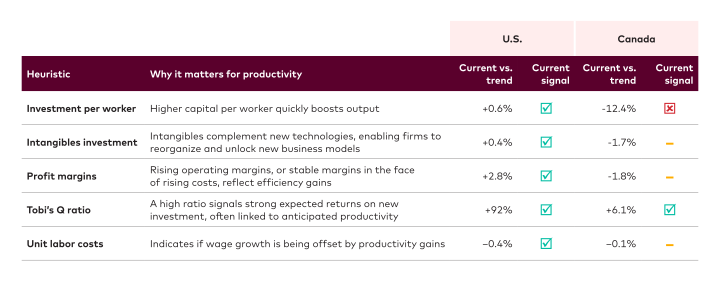
More broadly, the evidence does not yet suggest that AI is delivering measurable productivity gains at the macro level in Canada. Early indicators remain modest, as evident in Figure 1 below, reinforcing the view that the economy is still in the initial phase of adoption, where investment and integration precede widespread efficiency gains.
Figure 1: Early signals point to AI-driven productivity gains in the US but not in Canada
Source: Vanguard calculations, based on data from the Federal Reserve Bank of Cleveland FRED database, DataBuffet, Bloomberg, Macrobond, and the Bureau of Labor Statistics
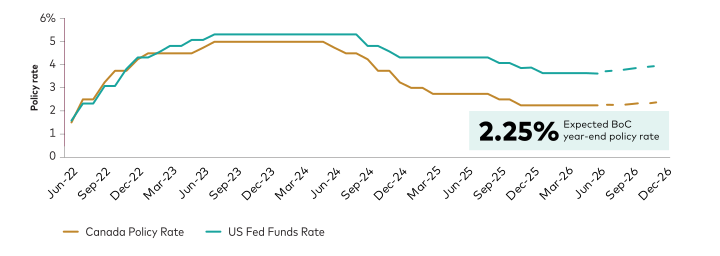
Figure 2: US and Canadian Policy Rates and expectations
Source: Bloomberg and Vanguard Research as of June 19, 2026
Canadian monetary policy is currently characterized by a deliberate pause, with the Bank of Canada maintaining its policy rate at 2.25 percent on June 10 as it navigates a complex macroeconomic backdrop. Policymakers assess that the current stance is appropriately calibrated to balance competing forces within the economy, including a weaker growth environment evidenced by a modest contraction in GDP in the first quarter of 2026 and persistent excess supply, alongside inflation dynamics in which headline inflation has been temporarily elevated by energy prices while underlying core measures remain contained in their trend.
As illustrated in Figure 2, Canadian bond markets continue to price in approximately one additional policy rate increase, a moderation from the one to two hikes that had been expected prior to the announcement of a 60-day ceasefire memorandum of understanding between the United States and Iran. In our view, such tightening is unlikely to materialize.
First, the Canadian economy continues to operate below potential, with residual slack evident despite emerging signs of stabilization in labour market conditions and expectations for a near term rebound in activity. This backdrop, combined with easing momentum in core inflation, provides scope for the Bank of Canada to maintain its policy rate on hold through 2026. Policymakers are also contending with an environment of elevated uncertainty, driven by oil price volatility, geopolitical developments, and ongoing trade negotiations, which reinforces the value of preserving policy optionality.
Second, core inflation, as measured by CPI median and CPI trim, is currently within the Bank of Canada’s target range at a 2.05 percent average. Third, there is little evidence of demand driven inflationary pressure, as economic slack persists and recent developments in the Middle East represent a supply side shock, an impulse that monetary policy is not well suited to address.
Fourth, the increase in bond yields and the associated rise in term premium have already contributed to tighter financial conditions, implying that the stance of monetary policy has become more restrictive through market channels.
Finally, the Bank of Canada appears to assess that the current inflationary impulse reflects a temporary supply shock that can be looked through, further reducing the urgency for additional policy tightening.
Alternatively, the case against policy easing is also grounded in the broader macroeconomic and policy environment. As noted previously, fiscal policy in Canada remains supportive, effectively placing a floor under how accommodative monetary policy can become. At the same time, the impact of trade tensions appears concentrated in specific sectors rather than pervasive across the economy, suggesting that broad-based monetary stimulus would be an imprecise and potentially inefficient response.
More fundamentally, monetary policy is ill-suited to address sector-specific dislocations. Easing financial conditions is unlikely to reverse structurally driven employment losses, such as those affecting auto workers in regions like Woodstock, Ontario, where job outcomes are tied more closely to trade dynamics and industrial restructuring than to the level of interest rates.
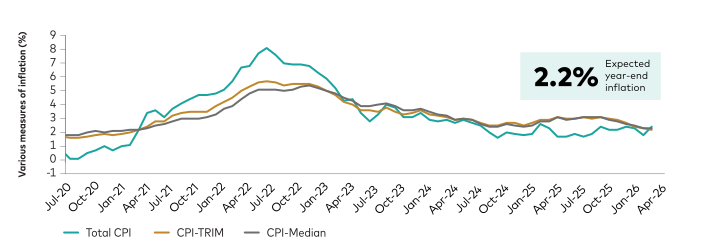
Our inflation view remains constructive. Headline CPI rose to 3.2% in May, but the increase was overwhelmingly driven by energy, with gasoline prices accounting for most of the upside surprise. By contrast, inflation excluding gasoline was 2.2%, while the Bank of Canada’s preferred core measures remained close to target, with CPI-trim at 2.0% year over year and CPI-median at 2.1%, leaving core inflation broadly around 2.3% and under control as Figure 3 below illustrates.
Figure 3: Core Inflation is at Target
Source: Statistics Canada
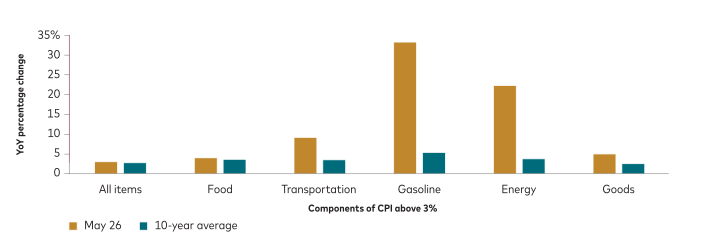
The broader message is that underlying inflation pressures remain far more benign than the headline suggests, with limited evidence that higher energy prices are feeding through in a meaningful way to the rest of the consumer basket. Figure 4 below highlights that energy and transportation inflation remain well above their 10‑year averages, while most other components are broadly in line with historical norms, even as overall goods inflation continues to run somewhat elevated.
Figure 4: Inflation: It’s (Mostly) an Energy Story
Source: Statistics Canada
There are several reasons for that view. First, there is still clear slack in the economy, and that slack is continuing to exert disinflationary pressure across a wide range of categories. Economic activity has been weak, the economy remains in excess supply, and the output gap is helping to offset the inflation impulse from higher oil prices. Second, some of the stickier components of inflation are still running high but are moving in the right direction. Grocery inflation has eased from earlier highs, rent inflation has decelerated, and mortgage interest costs have already turned negative on a year-over-year basis. Third, slower population growth should reinforce that cooling trend. Population declines are likely to further ease housing demand, which should put additional downward pressure on rents and home prices over time, while the currently soft housing backdrop is already weighing on housing-related goods demand.
That softer housing environment is also showing up in the goods channel. Home prices are falling, housing activity remains weak, and softer resale and construction conditions are consistent with lower demand for household durables such as furniture and appliances. We would add that tariff pass-through to consumer prices has been slow, helped by the removal of retaliatory tariffs, which should further limit upside pressure on core goods inflation. At the same time, higher bond yields are delivering an additional tightening impulse to the economy, which should restrain demand and reduce inflation pressure over time even without further action from the Bank of Canada.
None of this means the inflation shock is painless. The burden from higher energy prices is falling disproportionately on lower-income households, which spend a larger share of discretionary income on fuel and transportation, even if the macro-level pass-through beyond gasoline remains limited. Overall, our view is that the inflation story is still fundamentally one of headline volatility rather than renewed underlying price pressure, and we continue to expect core inflation to remain broadly steady at around 2.2% through the year.
Canada’s economy contracted modestly in the first quarter of 2026, with real GDP down 0.1 percent at an annualized rate. That marks a second consecutive quarterly decline and puts Canada in a technical recession. However, the contraction has been shallow, concentrated in trade exposed sectors and regions, and the data does not suggest a material, broad-based slowdown. That distinction matters because the headline GDP figures likely overstate economic weakness. There is meaningful scope for revision, as we saw with the sizeable revisions to 2025 GDP, and the income side of the accounts looked much firmer than the expenditure side in the first quarter. Real gross domestic income actually rose, helped by better terms of trade and stronger energy revenues, even as expenditure GDP slipped.
Recent weakness was driven mainly by softer government spending on defence related outlays and constrained business capital spending under the weight of persistent uncertainty. Residential spending was also notably weak, reflecting the ongoing drag from soft housing markets. Services spending held up reasonably well, but discretionary areas such as autos remained soft. GDP has also been hit by sectoral tariffs, especially in autos and steel, and by the wider chill in business confidence that comes from prolonged trade uncertainty. Exports have been weak in tariff sensitive sectors, especially autos, while imports were distorted by strength in precious metals and gold related flows, making the net trade picture look worse in the quarter.
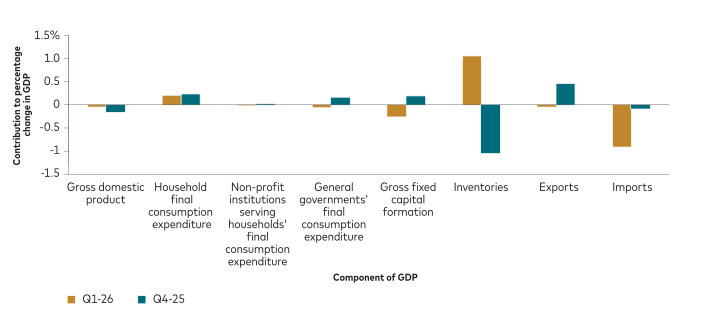
As shown in Figure 5, GDP data from Q4 2025 to Q1 2026 reveals considerable volatility across key components, including inventories, imports, fixed capital formation, and government spending. With the exception of imports, which has a negative contribution to percentage change in real GDP in both quarters, each component shifted between contraction in one quarter and expansion in another, underscoring the importance of focusing on underlying medium-term trends rather than short-term fluctuations.
Figure 5: Contributions to percentage change in real GDP
Source: Statistics Canada
Consumers have been the main shock absorber for the economy. Household spending did grow in the first quarter but largely through drawing down savings and leaning on wealth effects from stronger equity markets. The saving rate has fallen to 3.5 percent, which leaves less cushion going forward. That support is unlikely to be durable, especially with household income growth softening. Consumer spending will likely struggle more in coming quarters as higher gasoline prices erode purchasing power, and retail data already point to signs of pressure in real volumes. The burden is especially heavy for lower income households, even though many of them should benefit from the Canada benefits and essential package, and in our view much of that support will be spent rather than saved. That should provide some offset, but it does not change the fact that consumers have been supporting the economy at a time when underlying income growth remains weak.
There are still reasons not to become too pessimistic. CUSMA remains an important stabilizer and, so far, continues to shield much of Canada’s trade with the United States from a more severe tariff shock. Higher energy prices are also providing a lift to nominal GDP, trade revenues, and national income, even if those gains are unevenly distributed across provinces and households. In addition, stronger energy income, some support from higher real wages, and a likely rebound in trade and monthly GDP in the second quarter should help the economy look somewhat better after a very soft start to the year.
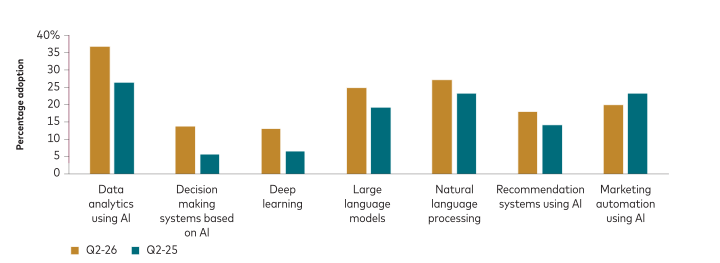
As shown in Figure 1, there is limited evidence so far of AI-driven productivity gains, despite broad-based business adoption across most areas (see Figure 6). Notably, adoption remains weaker in marketing automation. Additionally, Canada’s sector composition differs meaningfully from that of the United States, with a relatively smaller technology footprint, which may further temper the near-term productivity impact of AI, as evident from Figure 1.
Figure 6: AI Adoption by Business
Source: Canadian Survey on Business Conditions, second quarter of 2026
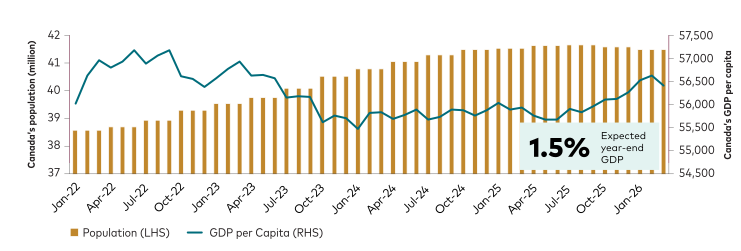
As shown in Figure 7, Canada’s GDP per capita has been trending higher despite a modest decline in March. This reflects our earlier expectation that slower population growth, particularly among temporary foreign workers and international students who are often concentrated in lower wage roles, would lift per capita output.
Figure 7: Shifting Population Dynamics Drive Higher GDP per Capita
Source: Statistics Canada
Our overall view is that while Canada is in a technical recession, the economy still looks more stalled than broken.
We have lowered our 2026 GDP forecast to 1.5%, with only a modest improvement to 1.6% in 2027. That outlook, however, remains sensitive to external risks, most notably the outcome of upcoming CUSMA negotiations.
Canada’s labour market has moved through a volatile first half of 2026, but the underlying dynamics point to a slowdown in hiring rather than a broad deterioration in employment. More than 100,000 jobs were lost between January and April, representing the steepest decline since 2021, before a sharp rebound in May that saw roughly 88,000 jobs created. On net, employment is down about 24,000 year to date, with full-time employment now back to roughly where it began the year. This volatility in headline employment masks a more stable underlying backdrop.
In our view, the labour market remains in a low hire, low fire environment. Firms are largely holding on to existing workers, and layoffs are not accelerating, which suggests there is no widespread or aggressive firing cycle underway. Instead, the primary challenge is weak hiring. Businesses are not expanding payrolls at the pace needed to absorb new labour supply, reflecting an uncertain operating environment shaped by ongoing trade pressures and sectoral tariffs, particularly in manufacturing and autos. Hiring intentions are still present, but firms appear to be delaying decisions until there is greater clarity on trade and the broader economic outlook.
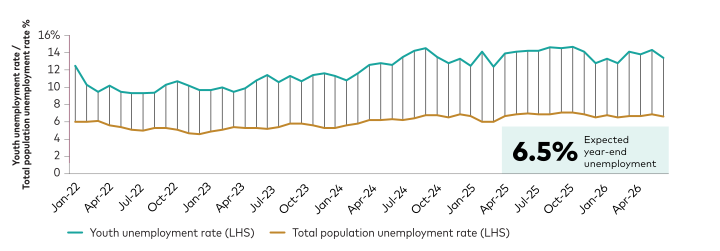
This imbalance is most visible among new entrants to the labour force. Younger workers and those re-entering the workforce are finding it increasingly difficult to secure employment, as hiring has not kept pace with labour supply. The result is a rise in unemployment that is not driven by job losses, but by insufficient job creation. The youth unemployment rate stands at 13.4 percent, compared with just 5.6 percent for prime-age workers, highlighting a widening gap in labour market outcomes across age groups. This reflects both cyclical weakness and structural pressures, including a growing mismatch between education and labour demand. Over the past decade, the number of university graduates has increased by more than 63 percent, while demand for degree-requiring jobs has risen by only 16 percent, leaving many qualified workers competing for a limited pool of opportunities.
The labour market also shows clear regional divergence. In manufacturing-heavy regions such as London, Ontario, the unemployment rate is 8.4 percent, reflecting direct exposure to sectoral tariffs and trade sensitivity. By contrast, regions like Quebec City, where employment is more concentrated in government and sectors less exposed to global trade, have unemployment rates as low as 3.8 percent. This dynamic underscores how external trade pressures are shaping labour market outcomes across the country.
Looking at Figure 8 below, we see that total unemployment fell to 6.6% from 6.9% and youth unemployment fell to 13.4% from 14.3%.
Figure 8: Youth Unemployment Holds Above 13 Percent While Overall Rate Stays Near 6.5 Percent
Source: Statistics Canada
Looking ahead, our expectation is that the labour market will stabilize rather than soften any further. The absence of rising layoffs provides an important anchor, and hiring should gradually recover as trade policy uncertainty gradually fades. Business surveys and other indicators suggest that hiring intentions have begun to improve, even as actual hiring remains subdued. In addition, slowing population growth and elevated retirements are beginning to reduce the pace of labour force expansion. This means that the economy no longer needs to generate the same level of job creation seen during the 2022 to 2024 period, when high immigration rates required gains of more than 60,000 jobs per month to maintain equilibrium. With a slower-growing workforce, the threshold for stable unemployment is lower, and in our view the unemployment rate is likely to end the year close to current levels around 6.5 percent.
Notes:
Publication date: July 2026
The information contained in this material may be subject to change without notice and may not represent the views and/or opinions of Vanguard Investments Canada Inc.
Certain statements contained in this material may be considered "forward-looking information" which may be material, involve risks, uncertainties or other assumptions and there is no guarantee that actual results will not differ significantly from those expressed in or implied by these statements. Factors include, but are not limited to, general global financial market conditions, interest and foreign exchange rates, economic and political factors, competition, legal or regulatory changes and catastrophic events. Any predictions, projections, estimates or forecasts should be construed as general investment or market information and no representation is being made that any investor will, or is likely to, achieve returns similar to those mentioned herein.
While the information contained in this material has been compiled from proprietary and non-proprietary sources believed to be reliable, no representation or warranty, express or implied, is made by The Vanguard Group, Inc., its subsidiaries or affiliates, or any other person (collectively, "The Vanguard Group") as to its accuracy, completeness, timeliness or reliability. The Vanguard Group takes no responsibility for any errors and omissions contained herein and accepts no liability whatsoever for any loss arising from any use of, or reliance on, this material.
This material is not a recommendation, offer or solicitation to buy or sell any security, including any security of any investment fund or any other financial instrument. The information contained in this material is not investment advice and is not tailored to the needs or circumstances of any investor, nor does the information constitute business, financial, tax, legal, regulatory, accounting or any other advice.
The information contained in this material may not be specific to the context of the Canadian capital markets and may contain data and analysis specific to non-Canadian markets and products.
The information contained in this material is for informational purposes only and should not be used as the basis of any investment recommendation. Investors should consult a financial, tax and/or other professional advisor for information applicable to their specific situation.
In this material, references to "Vanguard" are provided for convenience only and may refer to, where applicable, only The Vanguard Group, Inc., and/or may include its subsidiaries or affiliates, including Vanguard Investments Canada Inc.