Foundations of index fund investing
1. When John C. Bogle launched Vanguard 500 Index Fund on August 31, 1976, as First Index Investment Trust, he gave individual investors access to a strategy previously available only to institutional investors. The first index fund for individual investors embodied the Vanguard founder’s belief that most investors are better served by owning the whole stock market, at low cost, rather than trying to beat it.
2. Mr. Bogle hoped to raise $50–150 million in initial underwriting to launch Vanguard First Index Investment Trust. The offering raised a little more than $11 million—“an abject failure,” he later put it, in his characteristically blunt style. But what began as an experiment—“Bogle’s Folly,” to some—eventually became a default investment approach for millions.1
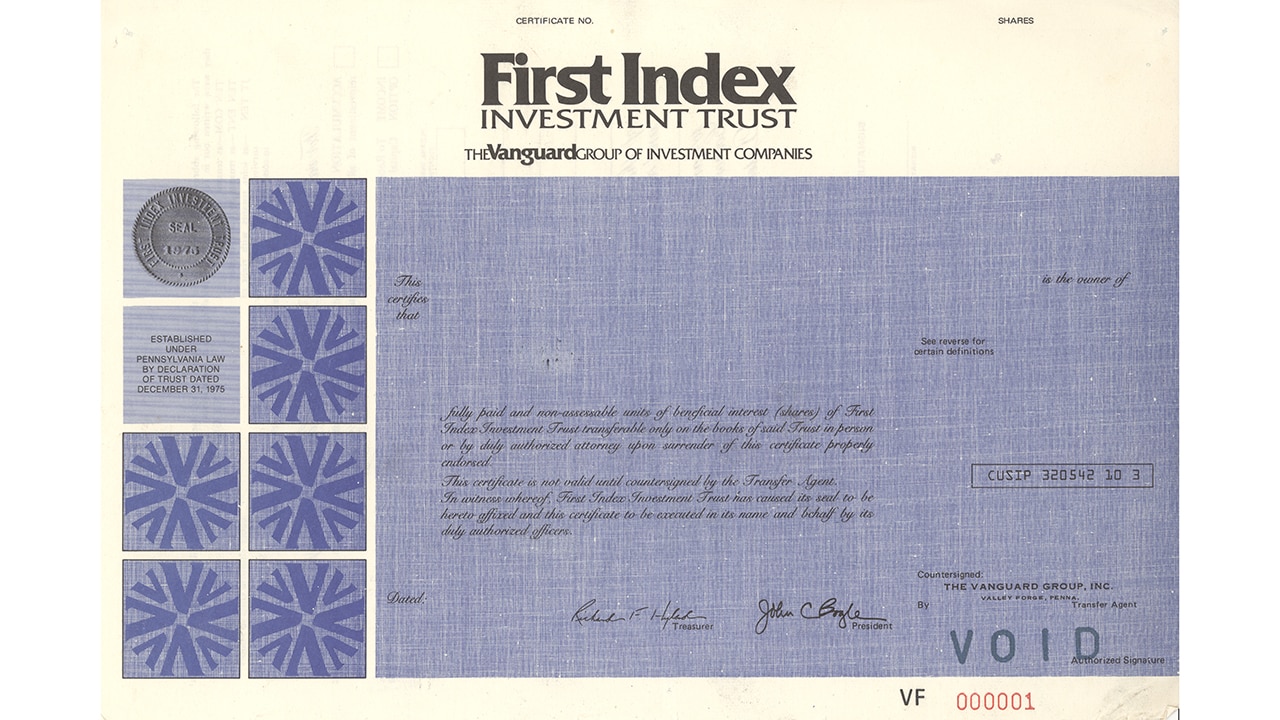
Share certificate for the first index mutual fund, later renamed Vanguard 500 Index Fund.
3. A few months after the launch of First Index Investment Trust, an article in an investment professionals’ journal opened as follows: “An investor seeking expert opinion on index funds might well be confused by what he hears. One conclusion, usually expressed with considerable feeling, is that index funds are a ‘cop-out’ and a fad that will soon disappear. Apparently only a very small minority hold the opposite point of view. They consider index funds the wave of the future ….” 2
4. Jan M. Twardowski first led the portfolio management effort. In 1977, shortly after the First Index Investment Trust launched, a reporter for The New York Times wrote that Mr. Twardowski felt “that the fund’s ‘very low’ total operating costs ... will begin to prove more popular with investors.” 3
5. Academic support for the strategy preceded the first index-tracking portfolios for institutional investors and Vanguard’s offering for individual investors. In 1973, one such supporter, Princeton University professor Burton S. Malkiel, suggested a new investment instrument: “a no-load, minimum-management-fee mutual fund that simply buys the hundreds of stocks making up the market averages and does no trading (of securities) …. Fund spokesmen are quick to point out, ‘you can’t buy the averages.’ It’s about time the public could.” 4
6. In his 1951 undergraduate thesis for Princeton University, Mr. Bogle highlighted the crucial role of costs in the long-term returns earned by investors. He identified costs as a drag on the performance of the industry, which was then entirely actively managed.6
7. In the years following 1976, Mr. Bogle famously—and often—advised investors ....
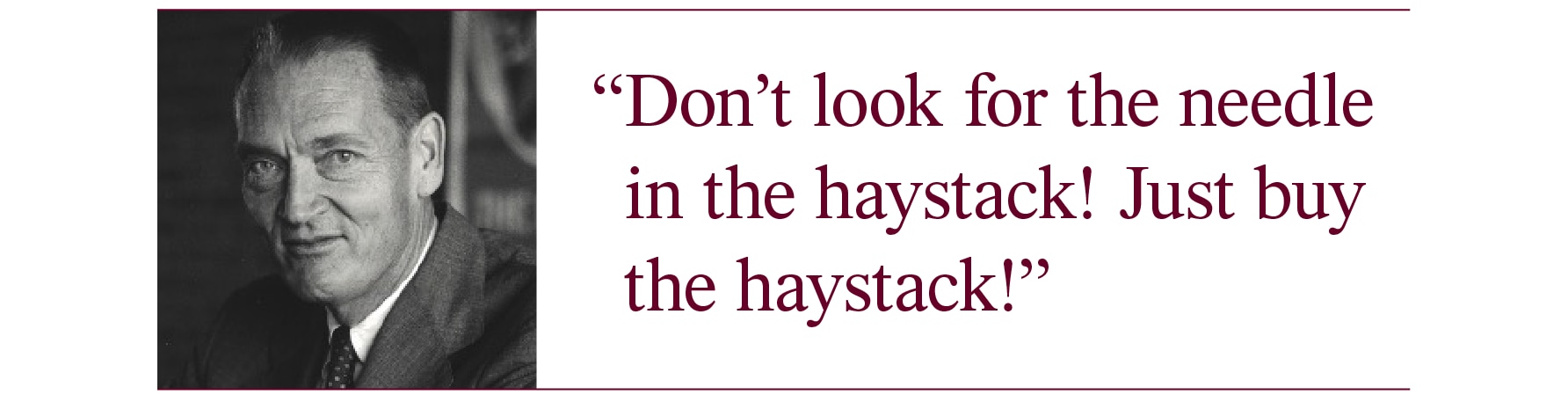
Vanguard founder John C. Bogle, pictured in 1989.
The important role of index investing
8. Indexing is integral to U.S. retirement savings. As of year-end 2024, 96% of defined-contribution retirement plans offered target-date funds, which rely on indexing as a core building block.5
9. 529 educational savings plans in the United States (the equivalent of RESPs in Canada) also rely to a meaningful degree on index funds, according to data from Morningstar.
10. Index funds can help to enhance market stability in times of market stress. Investors in index-based strategies tend to stay invested during periods of volatility, providing a reliable source of capital.
11. The diversity of index strategies allows investors to move capital across wide swaths of the market, enabling price discovery beyond a narrow group of stocks. That’s because different index funds hold distinct sets of securities, and reallocating assets among them leads to trades that contribute to price formation—even though the index fund investor isn’t making active stock picks.
12. Market data show that volatility and liquidity patterns have remained stable as index investing has grown, indicating that index funds coexist with—and support—well-functioning, dynamic capital markets.7
1 Vanguard’s founder recounted the initial fundraising for First Index Investment Trust—and indexing’s rise over the next 35 years—in a September 2011 guest column for The Wall Street Journal. (Subscription required.)
2 Walter R. Good, Robert Ferguson, and Jack Treynor. An Investor’s Guide to the Index Fund Controversy. Financial Analysts Journal, 1976, 32(6): 27–36. Introduction available at: https://www.tandfonline.com/doi/abs/10.2469/faj.v32.n6.27.
3 Phalon, Richard. Beating the Market or “Indexing” It? The New York Times, 1977. https://www.nytimes.com/1977/03/26/archives/personal-investing-beating-the-market-or-indexing-it.html.
4 This quote is from a 1997 Vanguard publication, The First Index Mutual Fund: A History of Vanguard Index Trust and the Vanguard Index Strategy. Vanguard founder John C. Bogle cites Malkiel’s call for an index fund in the latter’s 1973 book, A Random Walk Down Wall Street (W.W. Norton). Note that, for about the first six months of its existence, First Index Investment Trust was sold via brokers, and shareholders had to pay sales loads or commissions to purchase shares. All Vanguard funds adopted a no-load distribution strategy in early 1977. Also in 1977, Malkiel joined the boards of directors of the Vanguard funds.
5 Our source is the Vanguard report How America Saves 2025, available at https://workplace.vanguard.com/content/dam/inst/iig-transformation/insights/pdf/2025/has/2025_How_America_Saves.pdf.
6 Source: Morningstar research report, 2025 529 Savings Plan Landscape, August 2025. See, in particular, page 6.
7 James J. Rowley, Jr., Stephen Lawrence, and Ollie Ryder-Green. Setting the Record Straight: The Truths About Index Fund Investing. Vanguard, 2025. https://corporate.vanguard.com/content/dam/corp/research/pdf/setting_the_record_straight_the_truths_about_index_fund_investing.pdf.